

Record Wind, Surging Solar … But Are We Really on Track for Net Zero?
2025 will go down as a landmark year for Britain’s energy system.
Talk to Energy Oasis about how solar power can:
Renewables generated more electricity than ever before, coal disappeared entirely from the grid, and both wind and solar broke new records. On paper, it looks like a clean-energy success story.
But beneath the headlines, a more complicated truth is emerging: while renewable generation is rising fast, the pace, placement and integration of clean power still fall short of what’s needed to meet Net Zero targets, especially without a major expansion of solar at every scale.
At Energy Oasis, we spend less time celebrating record charts and more time asking a harder question:
Is the UK building the right renewables, in the right places, fast enough to cut costs, cut carbon and keep the lights on?
2025 in Numbers: A Record Year with Caveats
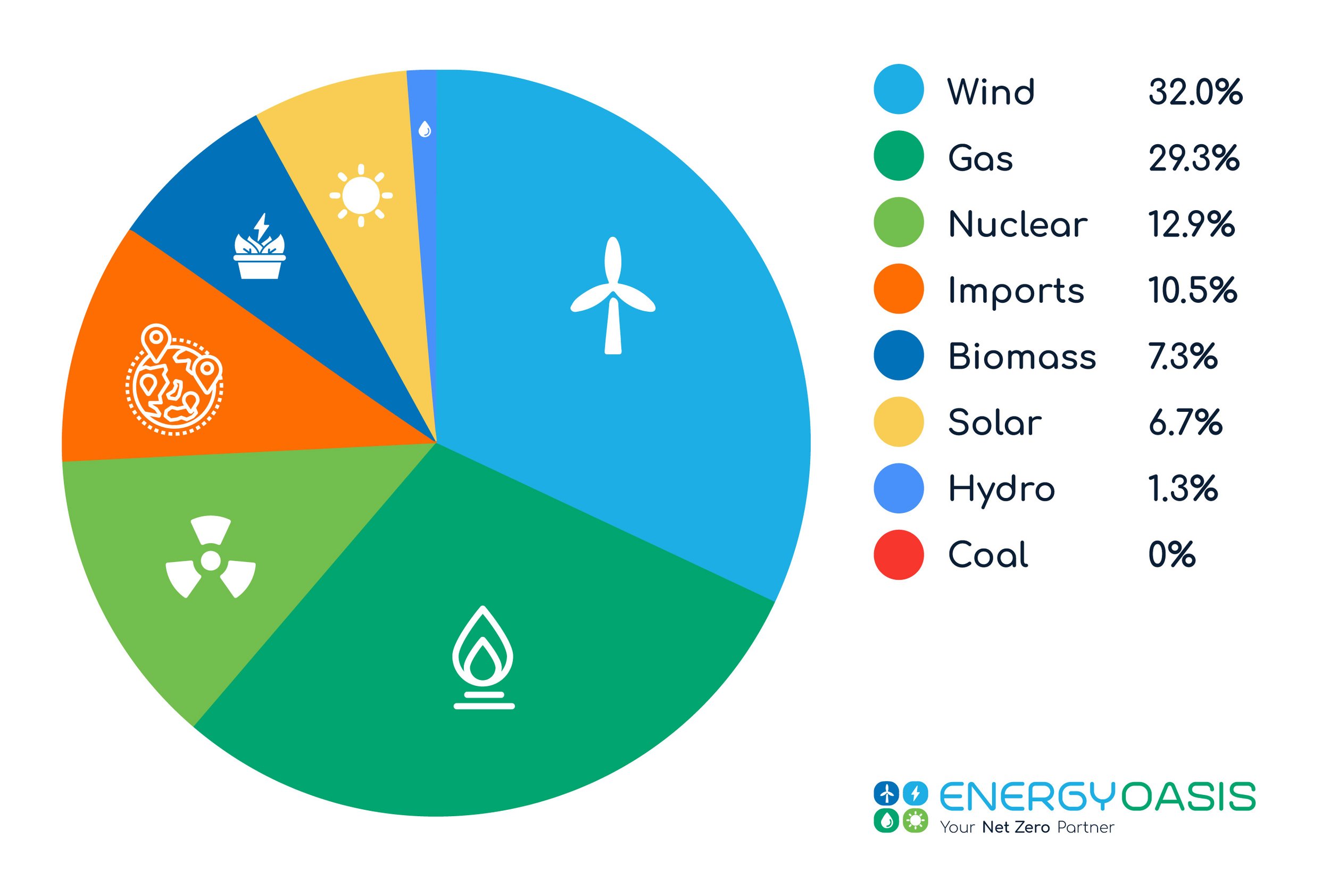
According to provisional data from the National Energy System Operator (NESO), renewable electricity generation reached more than 127 TWh in Great Britain in 2025, beating the previous record set in 2024.
Wind remained the single largest renewable source, generating 85+ TWh, nearly 30% of total electricity
Solar exceeded 18 TWh, supplying over 6% of Britain’s electricity
On peak summer days, solar briefly supplied over 40% of national power
Coal fell to 0%, making 2025 the UK’s first full coal-free year
These are genuine milestones and they matter. Every additional terawatt-hour of renewables displaces gas, reduces exposure to volatile fuel markets, and lowers carbon intensity.
But the same data shows why Net Zero remains elusive.
The Net Zero Reality Check: Why Gas Is Still Doing the Heavy Lifting
Despite record renewables, gas generation actually increased in 2025, rising to roughly 77 TWh - about 29% of total electricity.
That matters because:
Gas accounts for the majority of power-sector emissions
It fills the gaps when wind drops and solar fades
It remains the system’s “default backup” during cold, still, dark periods
In other words: renewables are growing, but not yet fast enough, or flexibly enough, to push gas out of the system entirely.
This is the crux of the Net Zero challenge. The issue is no longer whether renewables work. It’s whether they are being deployed in a way that matches real demand, real constraints, and real grid physics.
Why Solar Is the Quiet Workhorse of Net Zero
Wind rightly dominates headlines, especially offshore, but solar is emerging as the system’s most scalable, fastest-to-deploy solution.
2025 made that clear:
Solar generation grew by over 30% year-on-year
Around 250,000 new rooftop systems were installed
Costs continued to fall, making solar cheaper than new gas generation
Solar now plays a meaningful role in summer peak demand reduction
What’s often missed in national debates is that solar doesn’t need new seabed leases, decade-long grid upgrades or billion-pound substations to deliver value.
It works best when deployed:
Across farms, estates and brownfield land
Close to where power is actually used
This is where Energy Oasis sees the biggest untapped Net Zero opportunity.
Grid Constraints: The Problem Renewables Alone Can’t Solve
One of the less visible, but most important, barriers to clean power is the grid itself. Even in 2025, wind farms were still being paid to switch off during periods of oversupply, while gas plants ramped up elsewhere due to transmission bottlenecks. This highlights a critical truth:
Net Zero isn’t just a generation problem, it’s a systems problem.
Large-scale offshore wind is essential. But without:
Local solar generation
Battery storage
Smarter demand management
Decentralised energy systems
…the grid will continue to rely on gas for stability.
Solar, Storage and the Missing Middle of Net Zero
From an Energy Oasis perspective, the fastest route to a cleaner, cheaper system is not “either/or” it’s layering technologies intelligently.
-
Industrial estates with high daytime loads
Farms and rural businesses with space and predictable demand
Leisure, logistics and manufacturing sites exposed to peak pricing
-
Shifting solar power into evenings
Reducing peak grid imports
Providing resilience during outages or constraints
-
Matching generation to demand
Reducing waste before adding capacity
Avoiding unnecessary grid upgrades
This “missing middle” between national megaprojects and household installs is where Net Zero will either succeed or stall.
Community Concerns: Growth Without Trust Won’t Last
The rapid expansion of large solar farms has sparked increasing opposition in parts of Yorkshire, Lincolnshire and beyond.
These concerns shouldn’t be dismissed, but they also shouldn’t obscure the facts:
Solar uses around 0.1% of UK land
Many sites remain dual-use (grazing, biodiversity net gain)
Solar is among the cheapest and quickest power sources to deploy
The real challenge is not solar itself. It’s poor siting, poor engagement, and over-reliance on single solutions.
Smaller-scale, locally integrated solar projects, particularly on roofs and brownfield land, avoid many of these conflicts while delivering immediate benefits.
So… Can We Meet Net Zero?
The honest answer?
Yes - but not on autopilot.
2025 proves the UK can build renewables at scale. What it doesn’t yet prove is that we’re building them fast enough, evenly enough, or intelligently enough to eliminate gas by 2030.
From where we sit, Net Zero depends on:
Accelerating commercial and industrial solar
Pairing renewables with storage and controls
Reducing demand through energy efficiency first
Building resilience locally, not just centrally
This is where Energy Oasis focuses its work - not on headlines, but on delivery.
From Records to Reality
Record years are encouraging. But Net Zero won’t be achieved by records alone.
It will be achieved by thousands of practical decisions:
Which roofs get solar
Which sites add storage
Which businesses cut waste before adding capacity
Which communities are brought along, not pushed aside
If 2025 showed us what’s possible, 2026 needs to be the year we turn momentum into measurable, system-wide change.
If your organisation is exploring solar, storage or smarter energy systems - now is the time to act.
Read the government announcement on AR7 offshore wind capacity