

The UK’s Energy Mix 2025: Coal-Free, Wind-Led… But Still Gas-Heavy

The UK’s electricity system has just passed another historic milestone.
In 2025 we saw:
Zero coal in the generation mix
Record-breaking wind output
Renewables providing almost 40% of our electricity
But also a creeping reliance on gas, which still powers almost one in three kilowatt-hours
If you’ve ever wondered how much of our power really comes from wind, how big nuclear still is, or what “imports” actually mean, this update breaks down the UK’s energy mix in 2025 – and what it tells us about the road to Net Zero.
The UK’s Energy Mix in 2025 – At a Glance
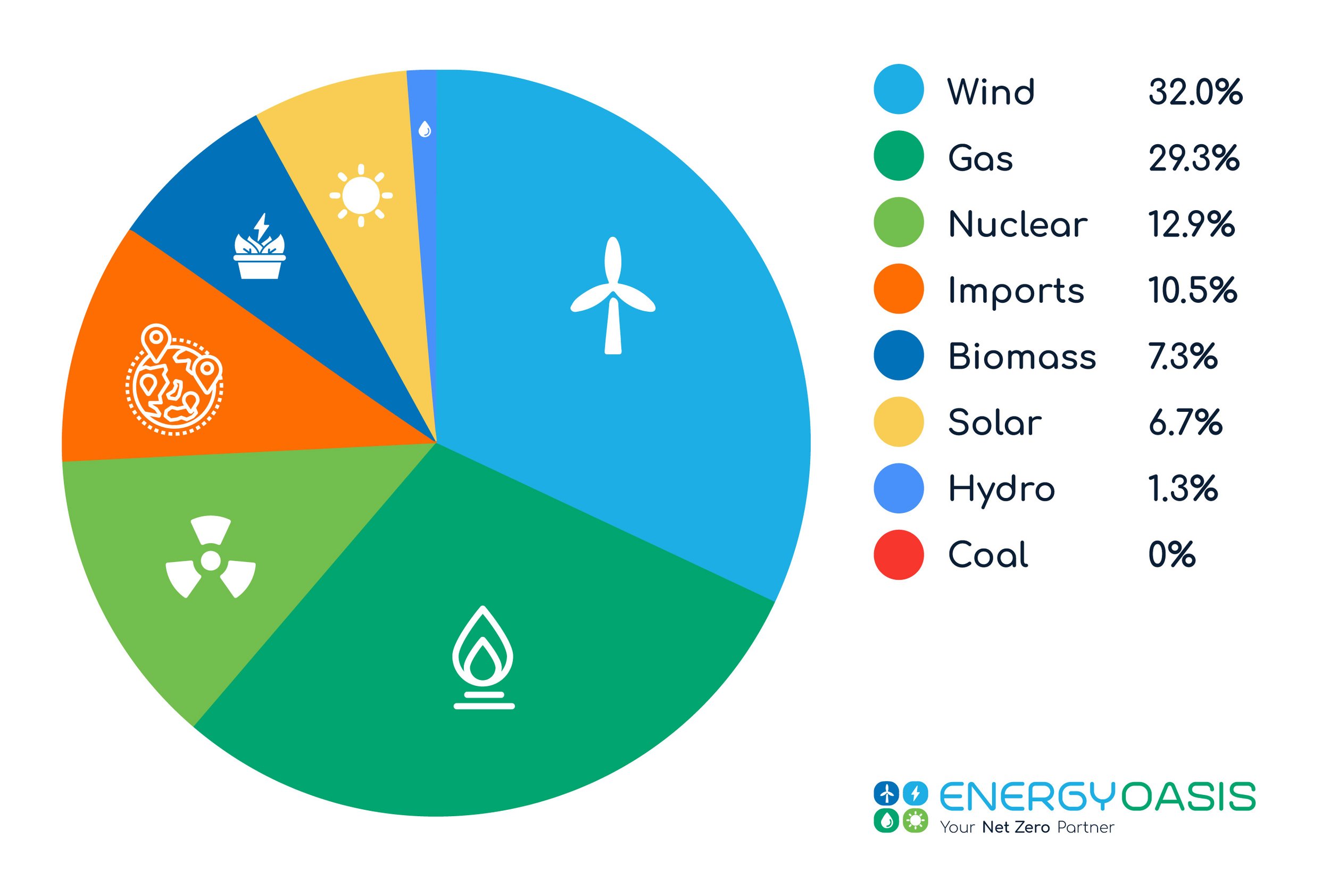
Based on National Grid data for the past year, Great Britain’s 2025 electricity mix looked like this:
You can compare that to 2024, when:
Wind provided 29.4%
Gas 25.9%
Nuclear 13.7%
Solar 4.9%
Coal still contributed 0.6%
Imports sat around 15.7%
Key takeaway:
In 2025, the UK was coal-free, more wind-led than ever, and slightly less dependent on imports – but gas has grown back to almost a third of the mix.
The Bright Spots: Records, Renewables and a Coal-Free Grid
1. Wind Power: Still the Backbone of UK Renewables
2025 cemented Britain’s reputation as a wind superpower.
Wind supplied about 32% of our electricity on average.
On 11 November 2025, British wind farms set a new record: 22.67 GW of generation between 7:30pm and 8:00pm.
Over the past year, renewables in total (wind, solar, hydro) generated around 40% of demand.
Key takeaway:
Wind remains the UK’s strongest clean energy asset – and there’s still room to build more capacity and better grid connections.
2. Coal at 0%: A 140-Year Era Ends
From the world’s first coal-fired power station in 1882 to the closure of the last station at Ratcliffe-on-Soar in 2024, coal powered over a century of British industry.
By 2025:
Coal’s share of electricity generation fell to 0.0%.
Over that 140+ year period, the UK burned an estimated 4.6 billion tonnes of coal, emitting 10.6 billion tonnes of CO₂.
That chapter is now closed.
Key takeaway:
2025 is the first full year in which the UK power sector is effectively coal-free. That’s a huge climate milestone – and one many countries are still decades away from.
3. Solar & Biomass: Quiet but Important Workhorses
Solar supplied 6.7% of generation – up from 4.9% in 2024.
Biomass contributed 7.3%, similar to last year.
Hydro remained small but steady at 1.3%.
The jump in solar highlights continued rooftop and solar farm build-out, even under mixed policy signals and British weather.
Key takeaway:
Solar still isn’t dominant, but it’s growing steadily – particularly on roofs, car parks and brownfield sites where it supports local self-sufficiency.
The Challenges: Gas Dependence, Nuclear Decline and Imports
For all the good news, the 2025 data also shows why the transition isn’t done.

1. Gas: Cleaner Than Coal, Still the Big Emissions Problem
Gas provided 29.3% of the UK’s electricity in 2025 – up from 25.9% in 2024.
It’s now responsible for the vast majority of power sector emissions.
Lower gas prices, flexible gas plants and gaps left by ageing nuclear have all nudged gas back up.
Key takeaway:
We’ve swapped coal for gas, which is cleaner, but still carbon-intensive. The next decade must be about pushing gas down as wind, solar, storage and demand-side flexibility grow.
2. Nuclear: Declining but Still Important
Nuclear’s share slipped from 13.7% in 2024 to 12.9% in 2025, reflecting ageing reactors and outages.
New projects like Sizewell C and future small modular reactors (SMRs) are planned, but:
They won’t arrive in time to cover all the decline.
The gap has mostly been filled by gas and imports, not by new low-carbon capacity (yet).
Key takeaway:
Nuclear is still a key source of stable, low-carbon baseload, but the UK can’t rely on it alone to balance the grid as older stations retire.
3. Imports and “Other”: Still a Significant Slice
In 2024, imports accounted for about 15.7% of UK electricity. In 2025 that broad category of imports & other sits around 10.5%.
That’s still a large slice of our electricity coming from:
European interconnectors
Cross-border trades
Smaller or “miscellaneous” sources
Imports can be a strength – they let us share power between markets – but they also:
Expose the UK to price shocks elsewhere
Export a portion of profits and control overseas
Depend on interconnector and transmission capacity
Key takeaway:
The UK is still part of a shared European power system. Growing more domestic, distributed generation is the best hedge against political and price volatility.
FAQs – The UK’s Energy Mix in 2025
-
Renewables (wind, solar and hydro) supplied around 40% of the UK’s electricity in 2025, with wind alone generating 32% across the year. This makes renewables the largest low-carbon contributor to the national grid.
-
No. Coal fell to 0.0% of the UK’s electricity mix in 2025, marking the first full year in which the grid ran completely without coal generation. This follows the closure of the final coal plant in 2024.
-
Gas supplied 29.3% of electricity in 2025 because it is flexible and fills gaps when wind and solar output drop. However, it remains the biggest source of power-sector CO₂ emissions, which is why accelerating renewable capacity and battery storage is critical.
-
Solar saw the biggest year-on-year growth, rising to 6.7% of generation (up from 4.9%). Wind also reached new national records, supplying more than 22.6 GW during peak output.
-
It’s possible but challenging. Hitting the target requires:
Faster grid upgrades
More onshore and offshore wind
Large-scale battery and storage deployment
Rooftop and commercial solar expansion
Accelerated electrification and efficiency measures
The 2025 mix shows progress, but also the need to reduce gas dependence more aggressively.
-
Most businesses can significantly lower grid usage by combining:
LED lighting upgrades and controls (50–80% lighting reduction)
Solar PV on roofs or land
Battery storage for peak shaving
Energy audits to reveal waste and uncover ROI-positive improvements
This decentralised approach improves resilience, cuts costs, and reduces exposure to volatile gas prices.
Carbon Intensity: Cleaner, But Not Clean Enough
Over the past year, carbon intensity averaged around 129 gCO₂/kWh – slightly higher than the ~127 g in 2024, but far below historical levels.
The main drivers:
No coal (massive win)
Higher wind and solar (win)
A stubbornly high share of gas (problem)
Every kWh is much cleaner than it was ten years ago – but the gas share shows why we’re not done yet.
Turning the 2025 Picture into Action
So what does all this mean if you’re running a business, farm, hotel, logistics operation or community site?
The big system trends are clear:
Coal is gone
Renewables are strong but constrained by grid & planning
Gas is the fallback – and will stay expensive and volatile
Imports plug gaps, but at someone else’s price
There are three practical responses:
Use less energy from the grid
LED retrofits, controls and smart audits remove waste.
Many sites can cut lighting consumption by 50–80%.
Generate more on-site
Solar on roofs, barns, car parks and industrial units.
Where possible, wind and microgrids in rural areas.
Store and manage energy better
Battery systems smooth peaks and increase self-consumption.
Smart management ties everything together.
This is exactly where Energy Oasis works: helping businesses turn the big story of the UK’s energy mix into local, concrete changes that cut bills and emissions.
What’s Next for the UK’s Energy Mix?
Looking ahead to 2030 and beyond, we can expect:
More offshore and onshore wind
More rooftop and ground-mount solar
Growing battery and flexible demand
New nuclear, slowly arriving
A continued squeeze on gas – but only if renewables and efficiency keep accelerating
The 2025 picture is encouraging but unfinished: coal is gone, wind is leading, but gas is still too big.
If you want to understand what this means for your site – and how to cut your dependence on that 29.3% gas slice – get in touch with Energy Oasis for an energy audit or renewable feasibility study.
UK energy is changing fast. The question now is:
How much of your future power will you control?
UK’s energy future relies on scaling renewables, enhancing storage, and increasing grid resilience for a cleaner tomorrow. Contact Energy Oasis today for expert advice on renewable energy solutions for your business or community. Let's energise tomorrow together!
This article was crafted with the support of some fantastic web tools. A special thanks to Grid.iamkate, Energy Dashboard UK and NESO for their invaluable resources!